

BlackATL

Atlanta, a cradle of the Civil Rights Movement, has been a historic hub for Black entrepreneurship, higher education, and political activism. Once known as a “Black Mecca,” the city has experienced demographic changes since its inception in 1837. The metro area’s Black population grew fivefold since 1970 to 2.3 million, now ranking second nationally after New York. The city has seen significant shifts in the racial composition of its neighborhoods over the years, with some areas experiencing gentrification and a decrease in Black population. Black neighborhoods and racial equality in the featured “Black Neighborhoods and the Creation of Black Atlanta” exhibit and the “Mapping Inequality” visualization project below.


While demographic shifts have transformed neighborhoods, Atlanta remains a vital hub of Black political, cultural, and intellectual life. Black communities form the vibrant heart of metro Atlanta – from multigenerational African American families whose roots stretch back to the Civil Rights era, to more recent immigrants bringing Caribbean rhythms and African traditions to the city’s bustling neighborhoods. This legacy is preserved in projects like the Our Story digital exhibit, which showcases how Atlanta University Center institutions nurtured Black excellence in theater, dance, and scholarship. 


“Atlanta Georgia Skyline at Night with Skyscrapers and Light Trails”
by Shawn Kent, used under the Unsplash license.


Featured Project | Digital Projects | Articles | Further Reading | Teaching Materials

Featured Digital Project

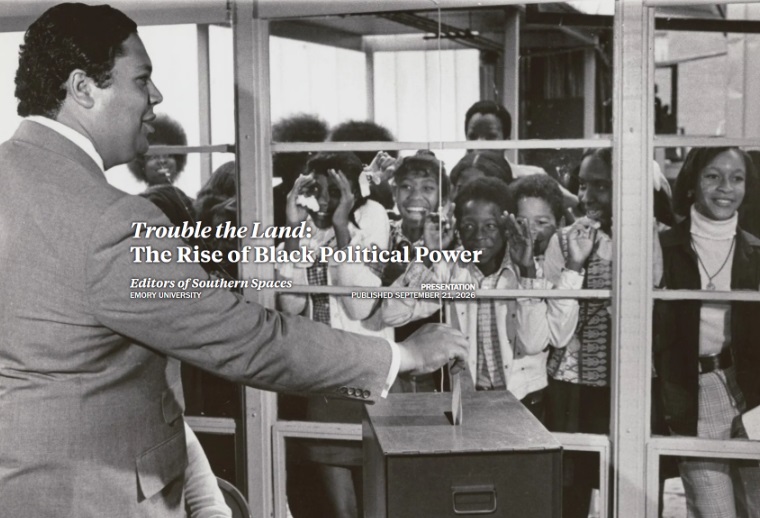
The Rise of Black Political Power traces Atlanta’s political transformation from the 1940s through the 1970s, as sustained voter registration and organizing shifted Black Atlantans from “being the balance of power to being the power.
Featured Digital Projects

The Atlanta University Center

While a Black population has always been present in Atlanta it has changed throughout time in both size and location.

Atlanta University Center Robert W. Woodruff Library
The digital exhibits showcase the AUC Woodruff Library’s archival and art collections, along with Galleries, Libraries, Archives, and Museums (GLAM) Center for Collaborative Teaching and Learning curated exhibits and learning resources.
Digital Library of Georgia

Atlanta was a hub of the Civil Rights Movement.

Featured Project

From the afterlives of slavery, Reconstruction, Jim Crow, and Civil Rights, Black Atlantans still grapple with the everyday legacies of inequality, visualized in this project from the University of Richmond.

Featured Digital Projects

The Counter Narrative Project

The Counter Narrative Project is a Black, queer narrative change organization for Black LGBTQIIA+ journalism.

ATL Maps

On this project users can search a variety of key words that are related to Black Atlanta and watch the map populate.

Georgia State University

This tour of Atlanta is linked, but there are many other tours that can be viewed at the OpenTourSite.

A map of household economics, housing and community, education, and health or environment are featured. Each map shows racial and class differences in the metro-Atlanta area.

Featured Articles

Historic Preservation Division, Georgia Department of Natural Resources

This article is an overview of Sweet Auburn’s evolution from a thriving African American business and cultural district to a historic neighborhood undergoing preservation and economic revitalization.

Adam Perry Newman

This article is a reflection on the “Still the Black Mecca?” Symposium with an accompanying interview from Kali-Ahset Amen, the Assistant Director of the James Weldon Johnson Institute at Emory University.

Kali-Ahset Amen
This is a scholarly exploration of how diverse Black communities in metro Atlanta create spaces of belonging, identity, and cultural connection, emphasizing the city’s role as a major hub within the global African diaspora.

Further Reading

  • Atlanta University Center. “Our Story: Photographs and Publications of the Atlanta University Center.” AUC Woodruff Library Digital Exhibits. Our Story gathers Atlanta-based HBCU archival collections into a digital exhibit on their contributions to intellectual culture over the years. 
  • Black Information Network. “Podcasts.” Atlanta’s BIN 640. The Black Information Network Podcasts maintain a comprehensive list of black-produced podcasts from Atlanta political and cultural influencers.
  • Collins, Brennan, Megan Slemons, and Jay Varner. “Explore Projects.” ATLMaps. ATLMaps explore Atlanta communities through archival maps, geospatial data visualization, and user-contributed media points.
  • Collins, Brennan, Megan Slemons, and Jay Varner. “Rap Map.” ATLMaps. Rap Map visualizes Atlanta’s rap music culture in the 90s and 2000s.
  • Department of City Planning. “Historic Preservation and Black Atlanta Series.” Future Places Project. Historic Preservation and Black Atlanta is a five-part seminar series on Atlanta’s black history, culture, and communities.
  • Discover Atlanta. “ATL Unguided.” Discover Atlanta. ATL Unguided, inspired by twentieth-century green books, is a black-centric travel guide to the city’s black businesses, clubs, art spaces, and community groups.
  • Emory Center for Digital Services. “OpenTour Builder.” OpenTour. Emory’s OpenTour Builder database features many narrative maps about black history and culture in Atlanta and Georgia more broadly.
  • Georgia State University Library. “digATL – The Digital Atlanta Portal.” Georgia State University Library. digATL is a database for projects, collections, and data about the Atlanta metro area organized by Georgia State faculty, staff, and students.
  • Mason, Skip. “Vanishing Black Atlanta History.” Facebook. Vanishing Black Atlanta History is a public-facing community archival page that collects the history of black Atlanta natives.
  • SimpleMaps. “Race Black in Atlanta, GA by Zip Code.” SimpleMaps.com. This Zip Code map annotates Atlanta’s black population density by zip code.
  • University of Minnesota.  “Umbra Search: atlanta (ga.).” University of Minnesota Library Archives and Special Collections Umbra Search African American History.